Why Your Salvation Is Trinitarian from Start to Finish
By Matthew Barrett

Are all three Persons of the Trinity part of our salvation?
Consider the trinitarian nature of salvation in Ephesians 1 and the inseparable operations of the Trinity.
One passage of Scripture instrumental to understanding salvation is Ephesians 1. As I studied it, I noticed Paul’s account of the sovereignty of God’s grace in our salvation is trinitarian from start to finish. So inseparable are Trinity and grace that Paul cannot describe our salvation without referring to all three persons of the Trinity. When I reread Paul’s words, Father, Son, and Holy Spirit popped out with prominent repetition.
For example, Paul says it is “God the Father” who has “blessed us in Christ” and “chose us in him [Christ]” before the world was created (Ephes. 1:3–4). We are elected by the Father and chosen in his Son. Next, Paul grounds our adoption in time and space in our eternal predestination. But he does not do so apart from the Trinity: God the Father “predestined us for adoption to himself as sons through Jesus Christ” (Ephes. 1:5). Yet not only does God the Father elect us in his Son from all eternity, he then sends his Son to die for his elect in history. That’s why Paul says in the verses that follow that it is “in him” [Christ] that “we have redemption through his blood, the forgiveness of our trespasses” (Ephes. 1:7). Far from ad hoc, the Trinity planned Christ’s death from the beginning.
What about the Spirit? Has the Third Person of the Trinity been left out? Not on Paul’s watch. What the Father planned and the Son accomplished, the Spirit has applied. “In him you also, when you heard the word of truth, the gospel of your salvation, and believed in him, were sealed with the promised Holy Spirit, who is the guarantee of our inheritance until we acquire possession of it, to the praise of his glory” (Ephes. 1:13–14). The Spirit is our assurance, the down payment until we secure in full that inheritance predestined for us from eternity.
When my eyes were opened to the trinitarian DNA of the doctrines of grace, I wondered, does the work of salvation say something important about the unity and plurality within the Trinity? Does the nature of redemption reflect the one who is simply Trinity?
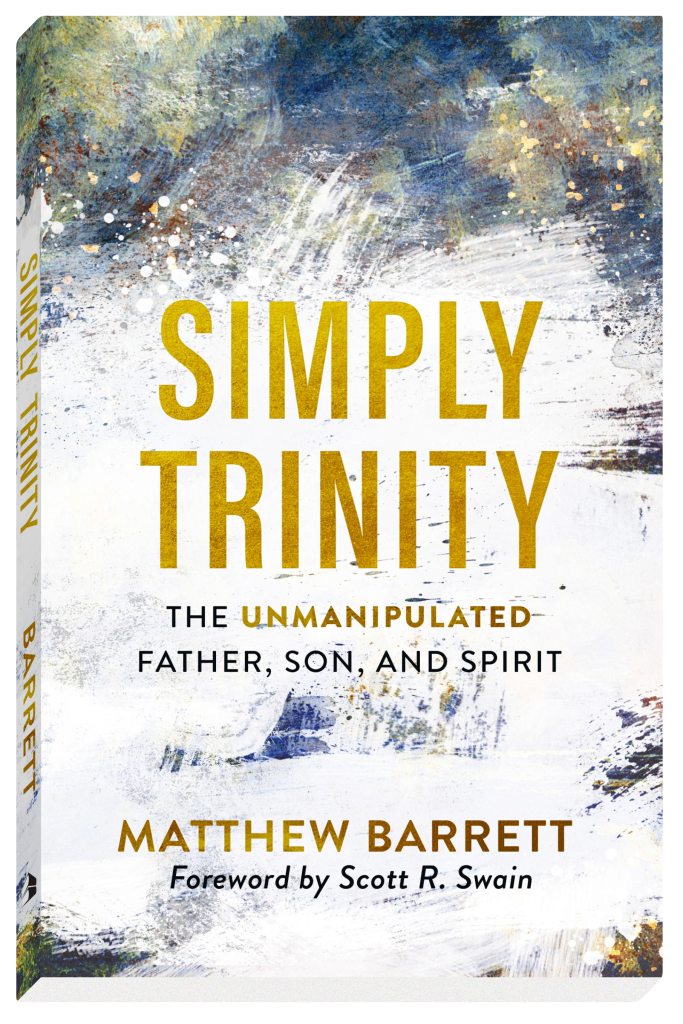
Simply Trinity
The Unmanipulated Father, Son, and Spirit
By Matthew Barrett
In this accessible text, author and theologian helps you grasp the doctrine of the Trinity so we can resist attempts to distort it and articulate the Trinity in a way that’s faithful to the Scriptures and impactful in our own lives.
Does God Act as One or as Three? Inseparable Operations
The correlation between who God is and what God does raises a difficult question: Does God act as one or as three? At first glance it might seem as if Father, Son, and Spirit act as three separate, independent persons. But this would mean there are three separate centers of consciousness and three separate wills, and the simple essence of God is divided as a result.
In contrast, will is not tied to person but to essence (nature). Since God has one essence, he has one will. His one essence and will subsists in three persons; those three persons remain undivided due to the one, single essence and will they have in common.
The unity we just highlighted has real implications for how God acts. It is because our triune God is one that he acts as one. Or better said, his action is one. His internal simplicity is exhibited in all the triune God’s external actions toward the world. There is a famous Latin phrase that captures this priceless trinitarian point: opera Trinitatis ad extra indivisa sunt. What does it mean? It means that the external works of the Trinity are undivided. Now why is that?
The three persons are undivided in their external works because they are undivided in their internal nature. As Augustine said in On the Trinity, “The Father, and the Son, and the Holy Ghost are inseparably united in themselves” since “this Trinity is one God,” and therefore “all the works of the one God are the works of the Father, of the Son, and of the Holy Ghost.” So, whenever we refer to the triune God’s action toward the world, we must recognize that it is an indivisible, singular action, as indivisible as the one, single essence the persons share in common. Likewise, whenever we refer to the triune God’s essence, we recognize that it is an indivisible essence, as indivisible as the one, singular action the three persons perform.
To clarify, the unity between Father, Son, and Spirit is not merely a cooperation between three separate persons. Again, that assumes each person has his own, individual will (three wills in God). That type of cooperation may give the appearance of unity, but it is not the unity of a triune God who is one in essence. Instead, we are left with three gods who get along with one another, each deciding he will cooperate with the other two.
Nor is this unity accomplished by a division of labor, as if there is one work to accomplish and that one work is divvied up among the three persons. As Augustine says, “if they do some things together and some without each other,” then the Trinity “is no longer inseparable.”
When we say God acts as one, we assume he is one. Since his very nature or essence is one, he acts as one, not merely cooperating but performing a single act that accords with the triune God’s single will. Yes, there are three persons, but since it is the same divine essence subsisting in each, these three persons always perform the same act.
I cannot emphasize this enough: one and the same action, one and the same divine nature. The three act as one because they are one; they act “in virtue” of the one nature they hold in common.
In theology, this unity-in-act is called inseparable operations. The three persons are without separation or division in their external operations toward the world, whether they be creation, providence, or redemption. Every operation is from the Father, through the Son, in the Spirit.
The Christian Life: Trinitarian from Start to Finish
As you can see, the Father, Son, and Spirit Work inseparably in salvation. Indeed, Paul was incurably trinitarian whenever he wrote about our salvation or the Christian life. For example, he says to the Thessalonians, “But we ought always to give thanks to God for you, brothers beloved by the Lord, because God chose you as the first fruits to be saved, through sanctification by the Spirit and belief in the truth. To this he called you through our gospel, so that you may obtain the glory of our Lord Jesus Christ” (2 Thess. 2:13–14).
Amen!
This article has been adapted from Matthew Barrett’s book Simply Trinity: The Unmanipulated Father, Son, and Spirit, published by Baker Books. In this accessible text, Barrett helps us grasp the doctrine of the Trinity so we can resist attempts to distort it and articulate the Trinity in a way that’s faithful to the Scriptures and impactful in our own lives.
Matthew Barrett is research professor of theology at Trinity Anglican Seminary, as well as the founder of Credo and the host of the Credo Podcast. He is the director of the Center for Classical Theology and the author of several award-winning books, including Simply Trinity and None Greater. He is currently writing a systematic theology.