Benjamin Vrbicek on Why the Church Can’t Lose Sight of Christ’s Return
Interview with Benjamin Vrbicek
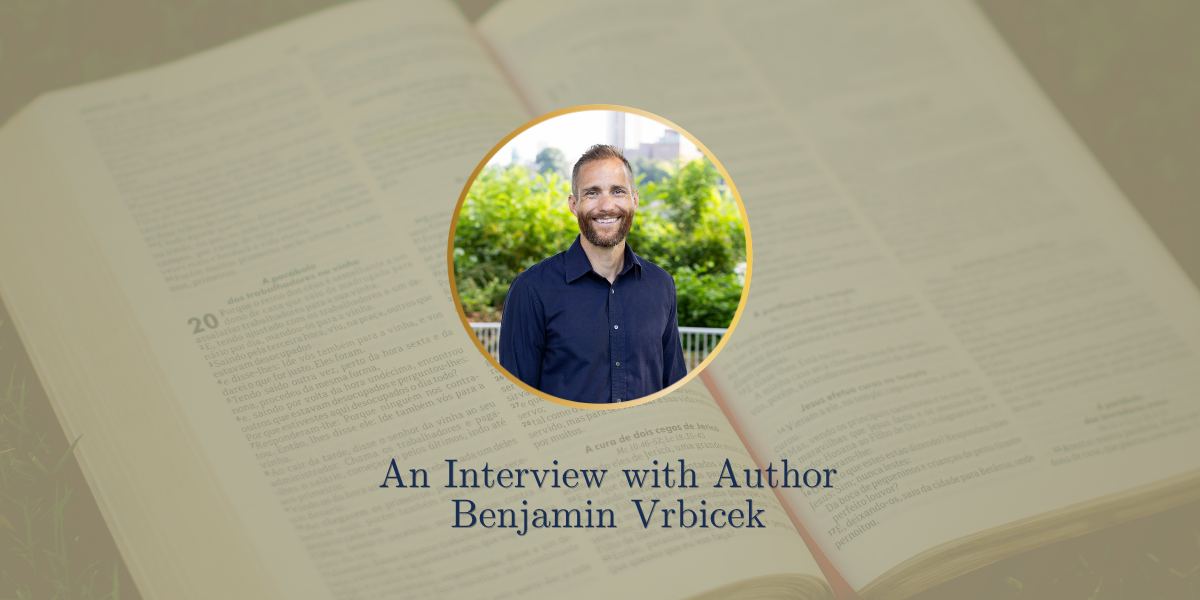
In this interview, inspired by his book The Restoration of All Things: How the Promise of Christ’s Return Brings Us Comfort Today, Benjamin makes the case that Christ’s return isn’t a peripheral appendage but a vital organ of the faith itself that sustains believers through the trials of life.
Drawing on his years in pastoral ministry, he explains why every Christian needs to think more about Christ’s return and how the “biggest truths” can become “brightest truths” in our darkest seasons.
Who is this book for? Who needs to think about Christ’s return?
My contention is that every Christian needs to think more about Christ’s return than they do.
This is a generalization, of course. I’m sure there are a few Christians who are exceptions. My experience in pastoral ministry and in interacting with Christians more broadly leads me to this conclusion. But, more specifically, the suffering Christian needs the reminder that we do not only live once: in the depths of despair, the believer needs the reminder that a day is coming when they will rise to never die again.
You argue that something has gone wrong in how the church thinks and talks about Christ’s return. What has been lost?
For many years, Christian teaching about the return of Christ has tended to focus on the controversial matters of the end times. The average Christian now mainly associates the return of Christ with debates, as though the Bible’s clear and repeated teaching on the return of Christ were actually a fuzzy, peripheral doctrine.
The writers of the New Testament couldn’t have seen it more differently. They confidently saw Christ’s return as bringing Christians the ultimate happily-ever-after: all of God’s people finally and fully glorifying him and enjoying him forever in a recreated and perfected paradise. So, what’s been lost with this neglect? When we relegate the return of Christ to controversy, we lose Christian hope and comfort.
You make the striking claim that you can’t lose the doctrine of Christ’s return and still have Christianity—it isn’t like a finger you can lose and live without; rather, it’s a vital organ. Can you elaborate?
A Christianity that focuses exclusively on the here and now is a Christianity that doesn’t exist in the pages of the New Testament. Paul states unequivocally in 1 Corinthians 15 that if the dead have not been raised, then Christ has also not been raised, and thus he can’t return, which would result in our faith being futile and Christians still in our sins.
I’ll give another “for instance” from 1 Corinthians. As much as I’ve thought and preached about this in our context, I’m still surprised at the emphasis on the end times in the New Testament. Last year we preached through all of 1 Corinthians in thirty-six sermons. That letter has at least twelve prominent passages about the end. Even in our church, where we try to focus on this regularly, we would be surprised to learn that one-third of those sermons should have focused on Christ’s return.
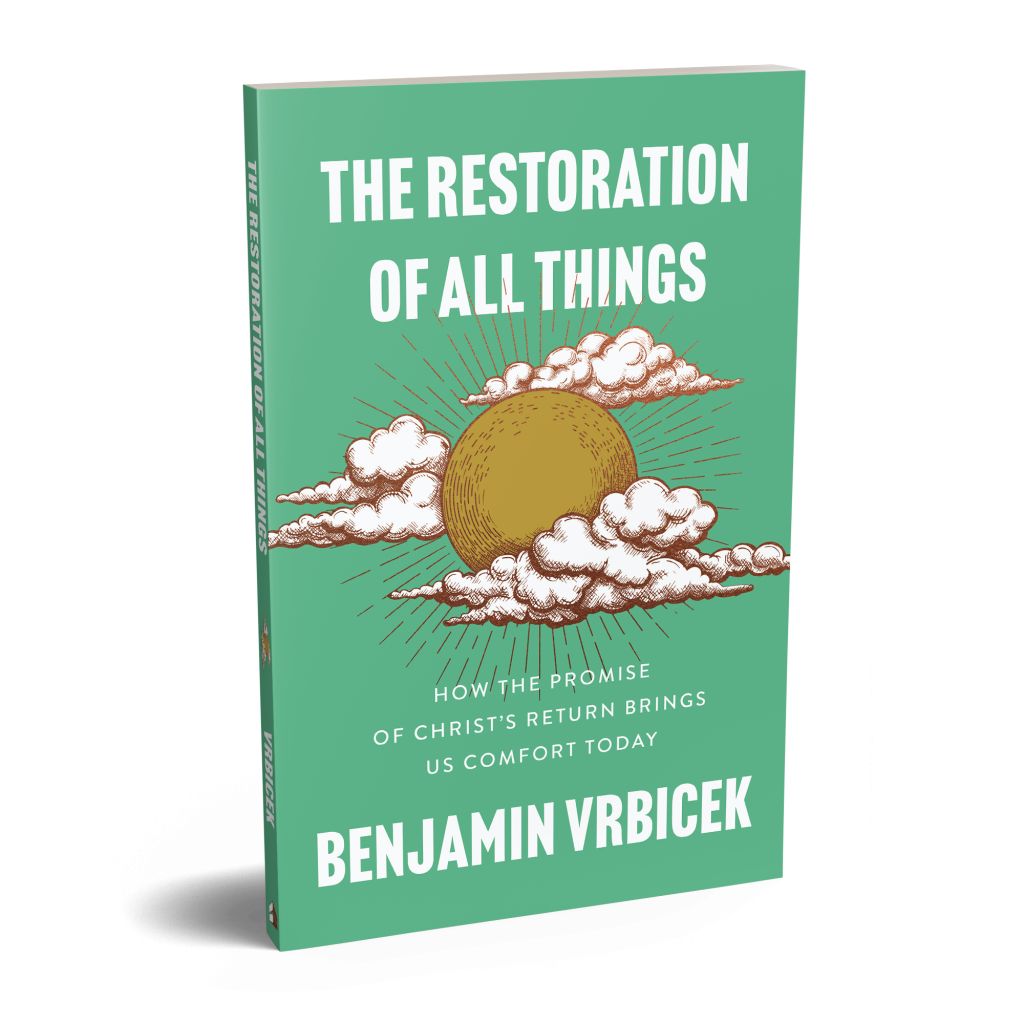
The Restoration of All Things
How the Promise of Christ’s Return Brings Us Comfort Today
By Benjamin Vrbicek
Leaving behind fear and politicization, this pastoral exploration of the end times shows readers why the return of Christ is the ultimate happily ever after, ushering in ultimate justice for the wronged, new bodies for the broken, and best of all, our faith in Christ becoming sight.
You point out that many Christians either neglect eschatology or are overly obsessed about minutiae and prophecy-charts. What is the essence of Christian eschatology and how can preachers faithfully proclaim what matters most?
I like to talk about the “biggest truths becoming the brightest truths.”
There is value in holding biblical convictions about the millennium, including when it occurs, who the antichrist might be, and how long the tribulation could last. But when you face incurable cancer, or your spouse commits adultery, or a country experiences genocide at the hands of an evil dictator, it’s more important to know there is a God who sees and knows and will come again to put the world right.
Knowing and loving these biggest truths until they become the brightest truths, I believe, is what will sustain believers through the hardships of life.
How has the promise of Christ’s return changed the way you pastor those who are suffering?
For those who are really, really suffering, everything feels hard. So I won’t pretend that tweaking an emphasis in pastoral counseling will make heavy suffering light. We remain jars of clay even with power from on high.
But I have seen both freedom and stability poured into people’s lives that doesn’t come from merely focusing on the healing that may or may not come in this life. There’s a kind of resilient hope that comes from knowing that if the worst of the worst happens in this life—if the shaking building really does fall down and collapse upon you while you’re inside—there is a life coming with no more sorrow, no more pain.
Tell us something about you that your readers might not know.
For the last five years, I’ve also been coaching two varsity sports at a local Christian school: cross country and track and field. As goofy as it might be, I try to stay in good enough shape to beat as many kids on the team as I can. While it makes me sad to lose, I also love seeing the smiles on their faces—and I love hearing the taunting they do—as the kids get good enough to beat their coach!
Benjamin Virbicek explores these themes more fully in his book The Restoration of All Things: How the Promise of Christ’s Return Brings Us Comfort Today. Leaving behind fear and politicization, this pastoral exploration of the end times shows us why Christ’s second coming is a source of comfort, hope, and clarity, especially for those who are suffering.
Benjamin Vrbicek is the lead pastor of Community Church in Harrisburg, Pennsylvania. He has written several books and writes regularly for Christianity Today, Desiring God, The Gospel Coalition, For the Church, 9Marks, and The Evangelical Free Church of America. He is also a writing staff member of and previous managing editor for Gospel-Centered Discipleship.