Recovering the Lost Christian Art of Dying Well
By Robert Kolb

Today, most of us try to avoid thinking about death. But for most of church history, Christians considered dying a skill. Dying was something to be learned. Ancient Christians prepared for death with handbooks, prayers, and songs. In this article, historian Robert Kolb reflects on the rich Christian tradition of dying well and the hope of rising with Christ.
Is dying an art?
Dying is certain. But to imagine that there could be an art to dying seems strange.
How Can We Die Well?
The traditional Christian phrase “the art of dying” comes from the medieval Latin terms ars, which meant “art” and “skill.”
How might a person develop the skill of preparing for death?
Nearly seven hundred years ago, Christians developed a kind of booklet with plans, or at least suggestions, to guide others in preparing to leave this earth, the Ars Moriendi. This volume seeks to provide stimulation for believers in Jesus Christ to think about their impending death and to live in the hope that the resurrection of Jesus bestows.
In any case—in every case—death comes, and all human beings have anticipated it, even to the point of striving to deny it. Life has contended and ended with death since humankind began to place other sources of stability and hope in the place of the Author of life, our Creator. He has come in human flesh and blood to conquer death, as Jesus of Nazareth. But is there an art, or a skill, to anticipating death? Can we come to terms with our mortality before the onset of the final struggle? Can we find comfort and peace as life fades?
People in every human culture have their ways of dealing with death, dying, and grieving. We have dealt with the loss of life through rituals of various kinds and through thoughts designed to provide support and comfort, and often safe passage to the afterlife, for those facing their own death and those dealing with the loss of a loved one.
Every tribe and nation leaves traces of its attempts to deal with death.
The specific literary genre of consolation in the face of death began around 300 BC with Crantor of Soloi’s meditation On Grief, written for his father upon the loss of his father’s other children. Christian theologians like Jerome and Augustine incorporated this tradition into their own works, as did Boethius and Isidore of Seville.
Why the Church Wrote Handbooks on Dying
The need for such literature became more acute when the Black Death swept over Europe between 1348 and 1352. In towns and villages that lost a quarter to half of their population, priests were overwhelmed by the task of bringing last rites to the dying, and often died themselves. Some tried to provide stopgap measures to enlist laypeople in the task of comforting the dying by providing handbooks on the art of dying (ars moriendi). The genre became an important tool for laypeople and clergy alike.
Such works flowed from the earliest printing presses with movable type. By the early sixteenth century, Western European Christians had a modest array of devotional reading material for the dying and the grieving.
The content of these and similar devotional tracts reflected a general reaction to the crisis of pastoral care that had enveloped several European Christian lands as the populace rebounded from the losses of the Black Death. Spiritual anxiety rose as people sought comfort. They compared their own lives with God’s standards and recognized the gap between human performance and divine demands. Religious leaders strove to make it easier to obtain the grace needed to perform truly God-pleasing works by lowering the standards for performance worthy of earning this grace. Those in charge of selling indulgences—which freed people from some obligations to work off temporal punishment for their sins in purgatory—reduced the price of their product. But such efforts did not provide relief for most, and the handbooks for dying seemed less and less effective in paving the path through purgatory to heaven.
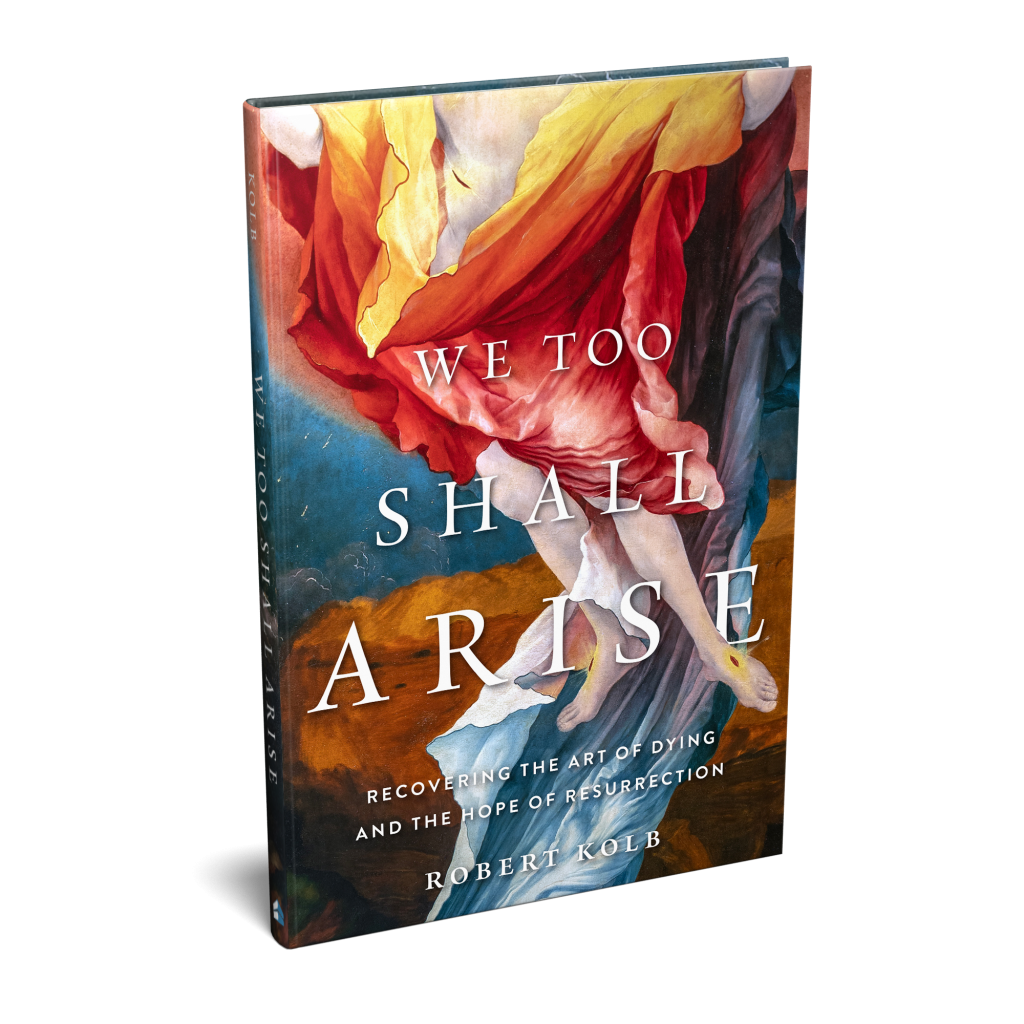
We Too Shall Arise
Recovering the Art of Dying and the Hope of Resurrection
By Robert Kolb
All of us will die, yet rather than preparing for death, we try to avoid thinking about it. This thoughtful examination of how Christians can live and die in the hope of resurrection draws on biblical and historical teaching from Martin Luther and others to help you walk through grief, live boldly despite chronic illness, and look forward to what is to come.
How Luther Reframed the Idea of Dying Well
In early 1519, hardly a year after Martin Luther’s Ninety-Five Theses on Indulgences had rocked Western Christendom, Martin Schart, a courtier in the government of Luther’s ruler, Frederick the Wise, asked Luther for counsel to aid him in dealing with thoughts of death. Luther’s own mentor, Johannes von Staupitz, had written a meditation on dying that pointed readers to Christ, and Luther recommended it to Schart.
But the challenge apparently intrigued Luther, and by November he had produced his own Treatise on Preparing to Die. The brief booklet outlined twenty points for consideration for Christians who knew that death was near. It turned the attention of the dying away from the physical sufferings that Jesus shared with other human beings and away from their own strivings for sufficient good works to gain God’s favor. It turned their attention instead to the sacrificial death and triumphal resurrection of Christ. In the 1520s, other early evangelical preachers tried their hand at such treatises. In preaching and devotional works, the Protestant reformers introduced new ways of preparing to meet the Maker.
My book We Too Shall Arise follows in their tradition. It focuses on Jesus Christ, who died in the place of sinners under the judgment of the law that condemns them to death (Rom. 6:23) and who rose from death to conquer all the enemies of his people (1 Cor. 15:54–57).
As death overshadows our lives, the risen Jesus overshadows death.
This article has been adapted from Robert Kolb’s book We Too Shall Arise: Recovering the Art of Dying and the Hope of Resurrection, published by Baker Books. In it, Kolb reflects on and recovers the rich Christian tradition of dying well and extends it for Christian readers today.