Corporate Worship Is More than a Habit—It’s Where Christ Meets Us
By Harrison Perkins

What if gathered worship isn’t primarily preperation for the Christian life but the primary way we experience connection with God?
This piece from Harrison Perkins explores why God’s means of grace find their fullest expression not in private devotion, but in the assembled life of the church.
When I was a kid, one of my favorite movies was The Sandlot, a coming-of-age story focusing on baseball. Among the kids on the team, Benny Rodriguez was the star player who had this wild ability to pitch to himself by just tossing the ball in the air in front of him. Being an annual participant on Little League teams, I of course attempted to emulate such a cool skill in my yard to practice by myself.
As it turned out, trying to enjoy playing baseball by myself was not very effective. My attempts at tossing the ball for myself turned out to be less a fruitful practice and more a game of “pick
up the ball off the ground.” Even when I made good contact with the ball, what happened? The brief excitement of a homerun swing quickly dissipated as I realized that running the bases was pointless, and now I had to go get that ball myself. Pretending I could play baseball alone was a fool’s errand.
In contrast to my piddly efforts alone in the yard, playing baseball on a team in a real game is charged with energy. Some things are built to be most effective as team activities.
The same principle applies to our experience of the means of grace. The means of grace are about connecting us to God. As it happens, they are also about connecting us to one another. God prioritizes our gathered worship as the place where he blesses his means of grace to bring about the most spiritual profit. In our private practices, we can manage something of the means of grace as we read and study Scripture in conjunction with prayer. Still, the foremost benefit of God’s means of grace comes from our use of them in gathered worship together as the church.
A Gathering of Gladness
In Psalm 84, the psalmist speaks wonderfully of God’s courts. The psalmist begins,
How lovely is your dwelling place,
O Lord of hosts!
My soul longs, yes, faints
for the courts of the Lord;
my heart and flesh sing for joy
to the living God.
Even the sparrow finds a home,
and the swallow a nest for herself,
where she may lay her young,
at your altars, O Lord of hosts,
my King and my God. (Psalm 84:1–3)
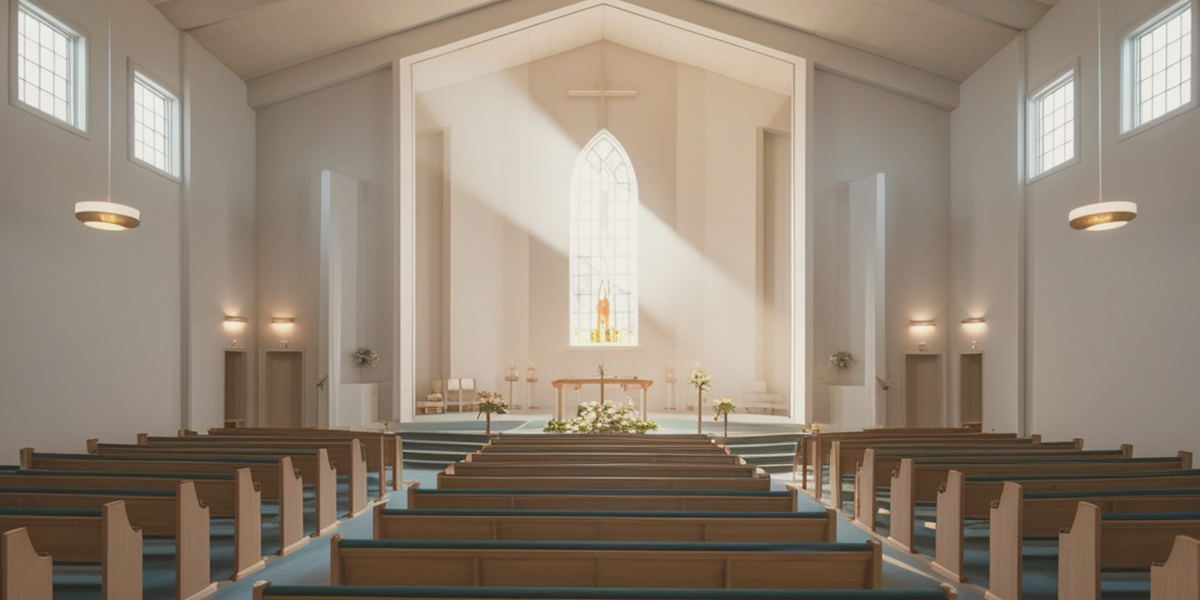
We have a new appreciation of the Lord’s dwelling place. He no longer dwells in Jerusalem’s stone temple. Rather, he is among the church assembled in Christ’s name. We see why it is such a delight to be in the Lord’s courts. His special presence resides there.

Meeting God in His Means of Grace
How Word, Sacrament, and Prayer Help Us Encounter Christ
By Harrison Perkins
For anyone feeling disconnected, overwhelmed, or stalled out in their spiritual growth comes this life-giving exploration of how God meets us, feeds us, and changes us through the ordinary means of grace—Word, sacrament, and prayer. These simple, God-appointed practices will enliven your worship and deepen your relationship with Christ.
Recovering the Delight of God’s Presence
How many Christians would be greatly helped by recovering the delight of God’s presence? At family reunions, we don’t question what else this meeting would help us achieve besides being with our family. When we sit down over our favorite meal, we don’t wonder how it will help improve our lives beyond the experience of its flavor. When my son falls asleep on my lap, I drink in the joy of how he knows that his dad cares for him and delights in him rather than asking what extra goal that nap accomplishes. We know intuitively that these experiences of delight are worthwhile for what they are in themselves.
Even in the church, at times, we forget that some moments need no greater purpose beyond what they are in themselves. Some moments are not means to other ends. We can easily miss the joy of delighting in the moment itself. We have perhaps even more so forgotten that Lord’s Day worship is not primarily for preparing us for something else so much as it is for delighting in and enjoying the presence of the Lord.
Worship Is Not a Means to an End
We must learn to recover an awareness of the present moment so that we might enjoy what gathered worship provides here and now. The prospect of some later and greater payoff is not what makes worship worthwhile. Rather, the truth that corporate worship is the activity of imbibing God’s presence enriches our experience of church. Since God applies Christ through his means of grace, then to pray both in our hearts and as we sing is to drink of Christ.
To be under the Word—to hear the Word as it is read and to hold the Word as we receive the sacraments—is to partake of Christ who personally comes to us through his Word. This value of blessed moments is why the psalmist pulls two astounding claims together in versus 4–7:
Blessed are those who dwell in your house,
ever singing your praise! Selah
Blessed are those whose strength is in you,
in whose heart are the highways to Zion.
As they go through the Valley of Baca
they make it a place of springs;
the early rain also covers it with pools.
They go from strength to strength;
each one appears before God in Zion. (Psalm 84: 4-7)
The blessing is to be in God’s house—in the place of his presence. But God meets his people foremost in the holy assembly. Hence, the psalmist continually repeated the value of meeting God in Zion. Our strength is in the Lord, and blessing comes upon our way because we sojourn to his people’s assembly. Our worship is a gathering of gladness because there we encounter the Lord as directly as we can in this life.
This article has been adapted from Harrison Perkins’s book Meeting God in His Means of Grace: How Word, Sacrament, and Prayer Help Us Encounter Christ, published by Baker Books. In it, Perkins explores how the ordinary matters of Christian life—reading the Word, participating in the sacraments, and prayer—uniquely draw us into communion with Christ.
Harrison Perkins is pastor of Oakland Hills Community Church (OPC), a senior research fellow at the Craig Center for the Study of the Westminster Standards, online faculty in church history at Westminster Theological Seminary, visiting faculty at Birmingham Theological Seminary, and a visiting lecturer in systematic theology at Edinburgh Theological Seminary. He lives in the Detroit metro area with his wife and son.